Truck underride: the short answer
A truck underride crash happens when a car slides under the back or side of a trailer, so the trailer hits the windshield and roof instead of the bumper. Federal rules require most big trailers to carry a rear impact guard built to a federal safety standard. 49 C.F.R. § 393.86(a)(1). A guard that is missing, bent, or too high off the ground is one of the first things to check after a truck underride wreck.
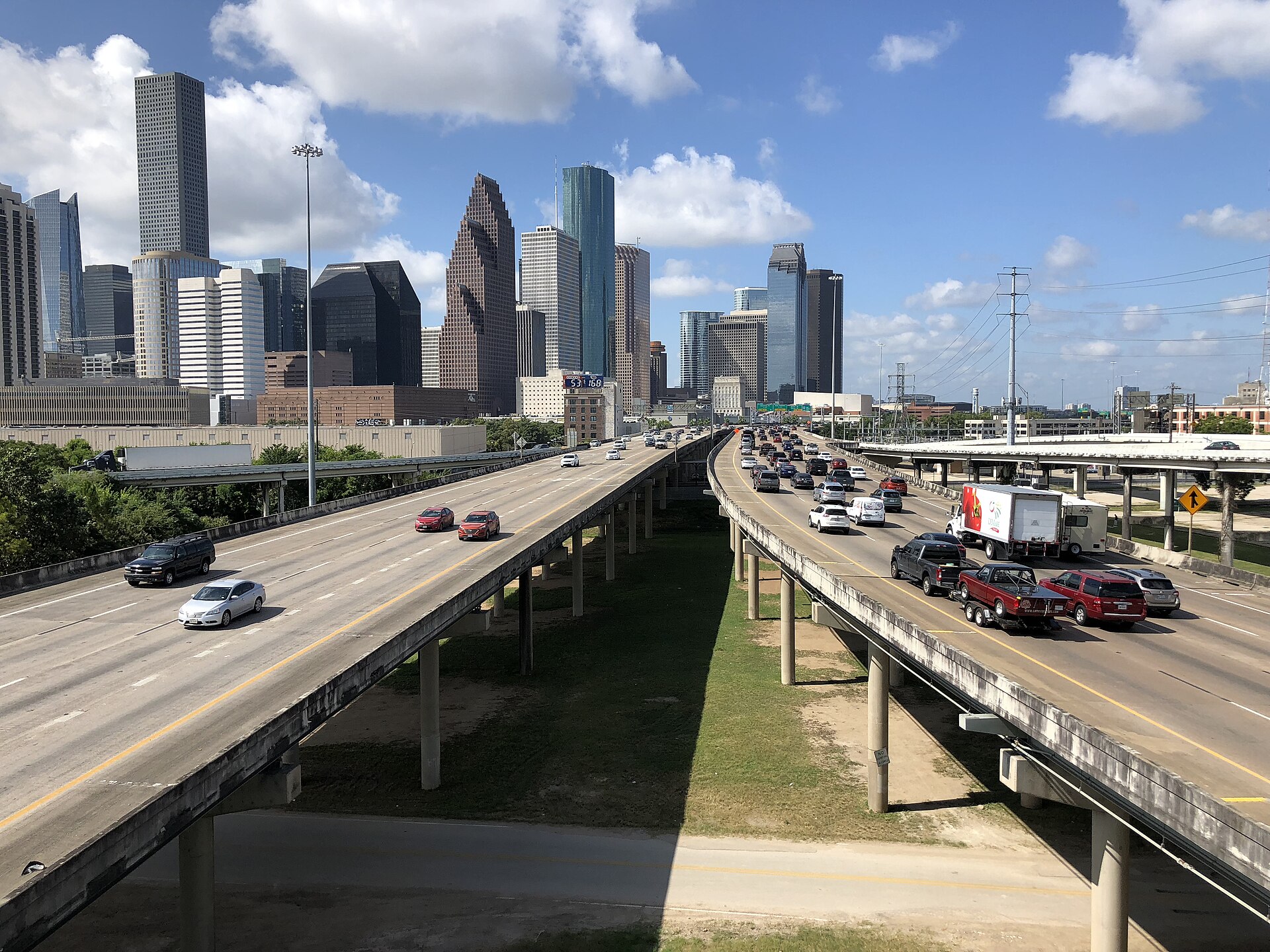
A truck underride wreck is one of the worst kinds of crashes on a Texas freeway. I’ll use I-45, the North Freeway in Houston, as the example, since 18-wheelers share it with commuters every day. But the rules below are federal and statewide. They work the same way on I-10 in Katy or a farm road in the Panhandle.
What is a truck underride crash?
In most wrecks, the bumper and crumple zones take the hit. That’s what they’re built for. In a truck underride crash, the car goes under the trailer, and those parts never touch anything.
For example, say Marisol is driving south on I-45 near downtown Houston after dark. A trailer is stopped in her lane. She brakes, but her car slides under the back of it. The trailer bed sits at about the height of her windshield.
That’s why the rear guard exists. Trailers and semitrailers rated at 10,000 pounds or more and built on or after January 26, 1998, must have a rear impact guard that meets the federal safety standard. 49 C.F.R. § 393.86(a)(1). The bottom of that guard can’t sit more than 22 inches off the ground at any point across its width. Id. § 393.86(a)(3).
Older trailers, and trucks that ride high in the back, fall under a separate rule. If the rear sits more than 30 inches off the ground when empty, they need a guard whose bottom is no more than 30 inches up. Id. § 393.86(b)(1). Not every trailer is covered by the 1998 rule. Pole trailers and some low chassis and special purpose vehicles are left out. Id. § 393.86(a)(1).
So the first question in any truck underride case is plain. Was a guard required, and was it there?
Who can be responsible for a truck underride crash in Houston?
Often more than one party. That matters, because more than one party can mean more than one insurance policy.
First, the truck driver. Before driving, the driver has to be satisfied that the vehicle is in safe operating condition. 49 C.F.R. § 396.13(a).
Second, the trucking company. Every motor carrier must systematically inspect, repair, and maintain the vehicles under its control. 49 C.F.R. § 396.3(a). Parts covered by the federal equipment rules, which include the rear guard, must be in safe and proper operating condition at all times. Id. § 396.3(a)(1). A rusted or missing guard is a maintenance problem. And maintenance is the carrier’s job.
Third, visibility. Most big trailers built on or after December 1, 1993, must carry reflective sheeting, reflectors, or both, so other drivers can see them. 49 C.F.R. § 393.11(b). Dirty or missing tape is worth a close look in any nighttime wreck on the North Freeway.
When someone dies, Texas law also makes a person liable for a death caused by the wrongful act or neglect of that person’s agent or servant. Tex. Civ. Prac. & Rem. Code Ann. § 71.002(b). In other words, the company can’t simply point at its driver.
Money matters too. A for-hire interstate carrier hauling ordinary freight in a vehicle rated at 10,001 pounds or more must carry at least $750,000 in liability coverage. 49 C.F.R. § 387.9. For more on why truck cases differ from car wrecks, see this Houston 18-wheeler article.
How long do I have to sue after a truck underride crash in Texas?
Two years, in most cases. A personal injury suit has to be filed no later than two years after the day the claim accrues. Tex. Civ. Prac. & Rem. Code Ann. § 16.003(a). A death claim also has two years, and that clock starts on the day the person dies. Id. § 16.003(b).
Two years sounds like plenty. In a trucking case, it isn’t, because the company’s own records run on a shorter clock. More on that below. For how the deadline works in general, see the statute of limitations article.
What will the insurer argue after a truck underride crash?
Here’s the catch. In a rear underride wreck, the car hits the truck from behind. So the other side will often say the car’s driver was following too close or looking at a phone.
That argument doesn’t end the claim. Texas uses proportionate responsibility. An injured person is barred only if their share of responsibility is greater than 50 percent. Tex. Civ. Prac. & Rem. Code Ann. § 33.001. At 50 percent or less, the damages are reduced by that percentage. Tex. Civ. Prac. & Rem. Code Ann. § 33.012(a).
So if a jury puts Marisol at 20 percent and the trucking company at 80 percent, she still recovers, minus 20 percent. Also, a defendant found more than 50 percent responsible is jointly and severally liable for the damages the claimant can recover. Tex. Civ. Prac. & Rem. Code Ann. § 33.013(b)(1). The 51 percent rule article walks through the math.
Expect an early phone call, too. An adjuster may ask for a recorded statement within days. That call comes from the side that pays the claim, and the answers can be used later to argue shared fault.
What can someone hurt in a truck underride crash recover?
Texas sorts most damages into two buckets. Economic damages pay for actual money losses, like medical bills and lost pay. Tex. Civ. Prac. & Rem. Code Ann. § 41.001(4). Noneconomic damages cover the rest, including physical pain and suffering, mental anguish, disfigurement, physical impairment, and loss of enjoyment of life. Id. § 41.001(12).
In an underride wreck, the trailer meets the car at windshield level. So the people in the front seats take the impact directly, and the losses can be severe.
When the crash is fatal, the wrongful death claim belongs to the surviving spouse, children, and parents. Tex. Civ. Prac. & Rem. Code Ann. § 71.004(a). One or more of them can bring it for the benefit of all. Id. § 71.004(b).
Steps that protect a truck underride claim
First, the crash report. An officer who investigates a wreck with an injury or death has to write a report. Tex. Transp. Code Ann. § 550.062(a). It must be filed electronically within 10 days. Id. § 550.062(b). For what that report can and can’t do, see the police report article.
Second, the trailer itself. Photos of the rear guard, or the empty spot where it should be, matter. So do photos of the reflective tape and the lights. A damaged trailer can be repaired and back on the road quickly.
Third, the maintenance file. A carrier has to keep its inspection and repair records where the vehicle is housed or maintained for one year, and for six months after the vehicle leaves its control. 49 C.F.R. § 396.3(c). After that, this rule stops requiring them. That’s the shorter clock. The 18-wheeler evidence article covers the other trucking records and how fast they go.
Finally, the medical records. Treatment notes from the first visit on are what tie the injuries to the crash.
This article is general information about Texas law. If you need legal advice about your own situation, contact a licensed attorney.
Supporting text
The exact language behind each part of this truck underride article, in the order it is cited.
Truck underride guard rules: the regulation text
Supports: the truck underride guard requirement for newer trailers and its exceptions, because this paragraph sets the 10,000 pound and January 26, 1998 lines and lists the excluded trailers.
(1) General requirements for trailers and semitrailers manufactured on or after January 26, 1998. Each trailer and semitrailer with a gross vehicle weight rating of 4,536 kg (10,000 pounds) or more, and manufactured on or after January 26, 1998, must be equipped with a rear impact guard that meets the requirements of Federal Motor Vehicle Safety Standard No. 223 (49 CFR 571.223) in effect at the time the vehicle was manufactured. … The requirements of paragraph (a) of this section do not apply to pole trailers (as defined in § 390.5 of this chapter); pulpwood trailers, low chassis vehicles, special purpose vehicles, wheels back vehicles, and road construction controlled horizontal discharge trailers (as defined in § 393.5); and trailers towed in driveaway-towaway operations (as defined in § 390.5).
Supports: the 22 inch height limit, because this paragraph caps the gap between the guard and the ground.
(3) Guard height. The vertical distance between the bottom edge of the horizontal member of the guard and the ground shall not exceed 560 mm (22 inches) at any point across the full width of the member.
Older trailers and drivers: the regulation text
Supports: the 30 inch rule for older trailers and high-riding trucks, because this paragraph covers vehicles outside the 1998 trailer rule.
(1) Requirements for motor vehicles manufactured after December 31, 1952 (except trailers or semitrailers manufactured on or after January 26, 1998). Each motor vehicle manufactured after December 31, 1952, (except truck tractors, pole trailers, pulpwood trailers, road construction controlled horizontal discharge trailers, or vehicles in driveaway-towaway operations) in which the vertical distance between the rear bottom edge of the body (or the chassis assembly if the chassis is the rearmost part of the vehicle) and the ground is greater than 76.2 cm (30 inches) when the motor vehicle is empty, shall be equipped with a rear impact guard(s). The rear impact guard(s) must be installed and maintained in such a manner that: (i) The vertical distance between the bottom of the guard(s) and the ground does not exceed 76.2 cm (30 inches) when the motor vehicle is empty; …
Supports: the driver’s duty in a truck underride case, because this rule makes the driver confirm the vehicle is safe before driving.
Before driving a motor vehicle, the driver shall: (a) Be satisfied that the motor vehicle is in safe operating condition;
Trucking company duties: the regulation text
Supports: the carrier’s maintenance duty, because this paragraph requires systematic inspection, repair, and maintenance.
(a) General. Every motor carrier and intermodal equipment provider must systematically inspect, repair, and maintain, or cause to be systematically inspected, repaired, and maintained, all motor vehicles and intermodal equipment subject to its control.
Supports: the point that the rear guard must work at all times, because the guard is one of the part 393 parts this paragraph names.
(1) Parts and accessories shall be in safe and proper operating condition at all times. These include those specified in part 393 of this subchapter …
Supports: the reflective tape and reflector rule, because this paragraph requires a conspicuity system on most large trailers built since December 1, 1993.
(b) Conspicuity Systems. Each trailer of 2,032 mm (80 inches) or more overall width, and with a GVWR over 4,536 kg (10,000 pounds), manufactured on or after December 1, 1993, except pole trailers and trailers designed exclusively for living or office use, shall be equipped with either retroreflective sheeting that meets the requirements of FMVSS No. 108 (S5.7.1), reflex reflectors that meet the requirements FMVSS No. 108 (S5.7.2), or a combination of retroreflective sheeting and reflex reflectors that meet the requirements of FMVSS No. 108 (S5.7.3).
Death claims and insurance: the text
Tex. Civ. Prac. & Rem. Code Ann. § 71.002(b)
Supports: the point that a company answers for its agent’s or servant’s conduct in a death case, because this subsection says so directly.
(b) A person is liable for damages arising from an injury that causes an individual’s death if the injury was caused by the person’s or his agent’s or servant’s wrongful act, neglect, carelessness, unskillfulness, or default.
Supports: the $750,000 minimum for a truck underride defendant hauling ordinary freight, because this row of the federal table sets that limit.
(1) For-hire (In interstate or foreign commerce, with a gross vehicle weight rating of 10,001 or more pounds) Property (nonhazardous) $750,000
The deadline to sue: the statute text
Tex. Civ. Prac. & Rem. Code Ann. § 16.003(a)
Supports: the two-year deadline for a truck underride injury claim, because this subsection lists personal injury suits.
(a) Except as provided by Sections 16.010, 16.0031, and 16.0045, a person must bring suit for … personal injury … not later than two years after the day the cause of action accrues.
Tex. Civ. Prac. & Rem. Code Ann. § 16.003(b)
Supports: the two-year deadline for a death claim, because this subsection starts the clock on the date of death.
(b) A person must bring suit not later than two years after the day the cause of action accrues in an action for injury resulting in death. The cause of action accrues on the death of the injured person.
Shared fault: the statute text
Tex. Civ. Prac. & Rem. Code Ann. § 33.001
Supports: the more-than-50-percent bar, because this section stops recovery only above that line.
In an action to which this chapter applies, a claimant may not recover damages if his percentage of responsibility is greater than 50 percent.
Tex. Civ. Prac. & Rem. Code Ann. § 33.012(a)
Supports: the percentage reduction in the Marisol example, because this subsection reduces damages by the claimant’s share.
(a) If the claimant is not barred from recovery under Section 33.001, the court shall reduce the amount of damages to be recovered by the claimant with respect to a cause of action by a percentage equal to the claimant’s percentage of responsibility.
Tex. Civ. Prac. & Rem. Code Ann. § 33.013(b)(1)
Supports: joint and several liability, because this subsection applies it to a defendant found more than 50 percent responsible.
(b) Notwithstanding Subsection (a), each liable defendant is, in addition to the defendant’s liability under Subsection (a), jointly and severally liable for the damages recoverable by the claimant under Section 33.012 with respect to a cause of action if: (1) the percentage of responsibility attributed to the defendant with respect to a cause of action is greater than 50 percent;
Damages: the statute text
Tex. Civ. Prac. & Rem. Code Ann. § 41.001(4)
Supports: the economic damages bucket, because this definition covers actual money losses.
(4) “Economic damages” means compensatory damages intended to compensate a claimant for actual economic or pecuniary loss; the term does not include exemplary damages or noneconomic damages.
Tex. Civ. Prac. & Rem. Code Ann. § 41.001(12)
Supports: the list of noneconomic losses, because this definition names pain, anguish, disfigurement, impairment, and lost enjoyment of life.
(12) “Noneconomic damages” means damages awarded for the purpose of compensating a claimant for physical pain and suffering, mental or emotional pain or anguish, loss of consortium, disfigurement, physical impairment, loss of companionship and society, inconvenience, loss of enjoyment of life, injury to reputation, and all other nonpecuniary losses of any kind other than exemplary damages.
Tex. Civ. Prac. & Rem. Code Ann. § 71.004(a)
Supports: who owns a wrongful death claim after a fatal truck underride crash, because this subsection names the spouse, children, and parents.
(a) An action to recover damages as provided by this subchapter is for the exclusive benefit of the surviving spouse, children, and parents of the deceased.
Tex. Civ. Prac. & Rem. Code Ann. § 71.004(b)
Supports: the point that one family member can sue for all, because this subsection allows it.
(b) The surviving spouse, children, and parents of the deceased may bring the action or one or more of those individuals may bring the action for the benefit of all.
Truck underride evidence: crash reports and records
Tex. Transp. Code Ann. § 550.062(a)
Supports: the officer’s duty to write a report, because this subsection requires one for injury or death crashes.
(a) A law enforcement officer who in the regular course of duty investigates a motor vehicle collision shall make a written report of the collision if the collision resulted in injury to or the death of a person or damage to the property of any one person to the apparent extent of $1,000 or more.
Tex. Transp. Code Ann. § 550.062(b)
Supports: the 10-day filing deadline, because this subsection sets it.
(b) The report required by Subsection (a) must be filed electronically with the department not later than the 10th day after the date of the collision.
Supports: the one-year record clock in a truck underride case, because this paragraph sets how long maintenance records must be kept.
(c) Record retention. The records required by this section shall be retained where the vehicle is either housed or maintained for a period of 1 year and for 6 months after the motor vehicle leaves the motor carrier’s control.
